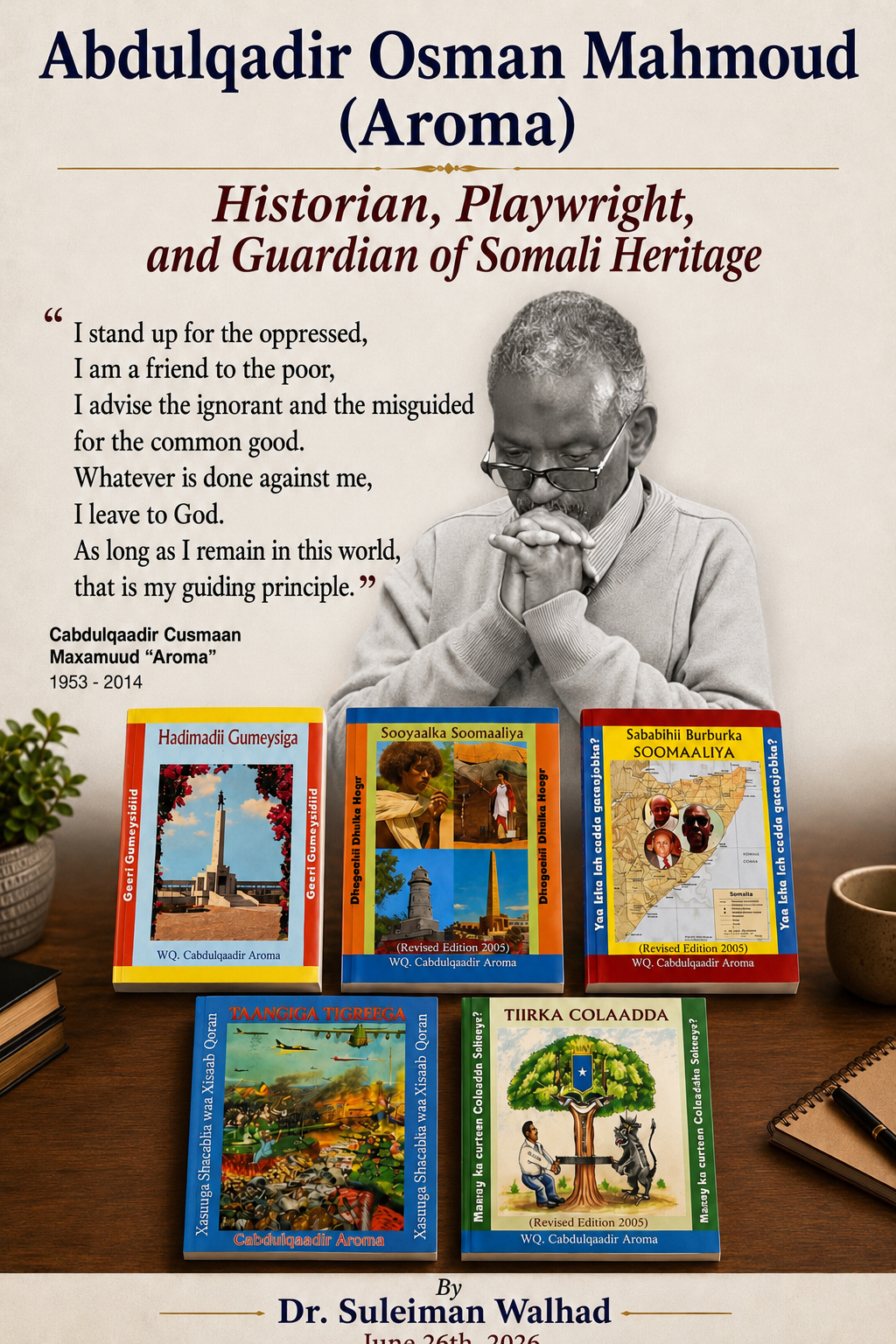
Abdulqadir Osman Mahmoud (Aroma)
Historian, Playwright, and Guardian of Somali Heritage
By
Dr. Suleiman Walhad
June 26th, 2026
Introduction
Abdulqadir Osman Mahmoud, widely known by his pen name Abdulqadir Aroma, was one of the most respected Somali authors, historians, playwrights, poets, and educators of the late twentieth and early twenty-first centuries. Through his writings and public engagement, he made an enduring contribution to the preservation of Somali history, literature, and cultural identity. His work combined historical research, literary creativity, and social commentary, earning him recognition as one of the foremost Somali-language intellectuals of his generation.
Born in 1953 in Dhusamareb, in central Somalia, Aroma grew up in a society where history, poetry, genealogy, and customary law were preserved largely through oral tradition. This early exposure inspired a lifelong commitment to documenting Somalia's rich cultural and historical heritage in written form. Rather than writing primarily for academic audiences, he sought to make Somali history accessible to students, teachers, and the wider public by publishing extensively in the Somali language.
Throughout his career, Aroma wrote influential books on Somali history, politics, customary law, and national identity. He was also an accomplished playwright whose dramatic works used satire and social criticism to address corruption, injustice, and the challenges facing Somali society. His ability to combine scholarship with engaging storytelling made his work both informative and widely appreciated.
Following the collapse of the Somali state in 1991, Aroma became increasingly dedicated to preserving historical memory and explaining the social and political forces that had shaped the country's past. His writings continue to serve as valuable resources for scholars, students, and members of the Somali diaspora seeking to understand their history and cultural heritage.
Abdulqadir Aroma passed away on 16th July 2014 in London, England. His legacy endures through his books, plays, and lasting contributions to Somali literature, historiography, and cultural preservation. In the following pages, I introduce a personal review of the man, his works, and his commitment to preserving a large part of the lives and lovies of Somali people
Notable Works of Abdulqadir Osman Mahmoud (Aroma)
Abdulqadir Osman Maxamuud (Aroma) produced an impressive body of work spanning history, politics, religion, drama, and cultural studies. Throughout his career, he sought to preserve Somali historical memory by documenting oral traditions, interpreting historical events, and examining the political and social forces that shaped modern Somalia. Unlike many historians who wrote primarily for academic audiences, Aroma wrote in clear Somali prose that appealed to students, teachers, and the wider public. His books remain among the most widely read Somali-language works on national history and identity.
Sooyaalka Soomaaliya (History of Somalia)
Perhaps Aroma's best-known publication, Sooyaalka Soomaaliya, is regarded as one of the most accessible general histories of the Somali people written in the Somali language. The book traces the development of Somali society from its earliest historical roots through the pre-colonial period, European colonial rule, independence, and the formation of the modern Somali Republic.
One of the strengths of the book is its integration of written historical records with Somalia's rich oral tradition. Aroma makes extensive use of oral narratives, poetry, genealogies, and traditional accounts alongside documentary sources to reconstruct the country's past. In doing so, he demonstrates that oral history constitutes an indispensable source for understanding Somali civilization.
The book also explores the evolution of Somali political institutions, clan organization, pastoral life, trade, Islamic scholarship, and relations with neighbouring peoples. For many Somali readers, Sooyaalka Soomaaliya became a standard introductory history because it presented complex historical developments in language that was both scholarly and accessible.
Tiirka Colaadda: Maxay ka Curteen Colaadaha Sokeeye? (The Roots of the Civil Conflict)
First published in 2002, with later editions appearing shortly thereafter, Tiirka Colaadda is Aroma's most influential political study. The book investigates the historical roots of Somalia's prolonged civil conflict and seeks to explain why the country descended into state collapse after 1991.
Rather than attributing the crisis to a single cause, Aroma examines a combination of historical, political, economic, social, and cultural factors. He discusses colonial policies, authoritarian governance, clan rivalries, competition for resources, weak institutions, and foreign intervention as interconnected elements that contributed to conflict.
A distinguishing feature of the book is its historical perspective. Aroma argues that many contemporary political problems have deep historical origins and therefore cannot be understood solely through contemporary events. His analysis encourages readers to examine Somalia's past in order to appreciate the complexity of its present challenges.
Today, Tiirka Colaadda continues to be cited by scholars studying Somali historiography and conflict.
Sababihii Burburka Soomaaliya: Yaa Iska Leh Eedda Qaranjabka?
This important work focuses specifically on the collapse of the Somali state. Aroma examines the constitutional, political, military, and social developments that gradually weakened national institutions before the government's eventual collapse.
The book addresses questions of political accountability while avoiding simplistic explanations. Instead, Aroma explores how leadership failures, institutional decline, clan politics, corruption, external pressures, and internal divisions combined over several decades to produce national crisis.
Particularly noteworthy is his discussion of Somali customary law (Xeer) and traditional systems of mediation. Aroma argues that customary institutions historically provided mechanisms for resolving disputes and maintaining social order, and he explores how these systems interacted with modern state institutions.
The book remains valuable for readers interested in understanding the structural causes behind Somalia's political instability.
Hadimadii Gumeysiga iyo Halgankii Ummadda (The Legacy of Colonialism and the People's Struggle)
Published in 2005, this volume examines the colonial experience in Somalia and the nationalist movements that ultimately led to independence.
Aroma discusses the administration of the British and Italian territories, the resistance movements that opposed colonial rule, and the emergence of Somali nationalism during the twentieth century. He pays particular attention to the aspirations of Somalis for political unity and self-determination.
Rather than presenting colonial history merely as a sequence of political events, Aroma analyses its long-term effects on Somali institutions, borders, education, and governance. The work, therefore, serves as both a history of colonialism and a study of its continuing influence on modern Somalia.
Taangiga Tigreega: Xasuuqa Shacabka Waa Xisaab Qoran
Published in 2008, this book reflects Aroma's engagement with contemporary political developments. It discusses the Ethiopian military intervention in Somalia and its humanitarian consequences, documenting civilian suffering while offering a critical political interpretation of the conflict.
Although more overtly political than his historical works, the book continues Aroma's broader concern with justice, sovereignty, and the historical experiences of the Somali people.
Al-Amru bil Macruuf wa Nahyu Canil Munkar
This work explores the Islamic principle of "enjoining what is right and forbidding what is wrong." Drawing upon Islamic teachings, Aroma discusses moral responsibility, ethical conduct, and the role of religion in public life.
The book illustrates another dimension of his scholarship by demonstrating his interest not only in history and politics but also in religious education and moral philosophy.
Articles, Essays, and Journalism
In addition to his books, Aroma contributed numerous newspaper articles, magazine essays, lectures, and public commentaries on Somali history, politics, literature, language, and culture. Much of this material appeared in Somali-language newspapers and periodicals both within Somalia and in the diaspora.
Unlike his books, however, these shorter writings have not been comprehensively collected or catalogued. Many remain difficult to locate because they were published in newspapers with limited circulation or were presented as lectures and conference papers. As a result, no complete bibliography of his articles is currently available in major international library catalogues.
Contributions Beyond His Books
Although Aroma is best remembered for his historical publications, his literary contributions extended well beyond conventional historical writing. He was an accomplished playwright whose dramatic works used satire and humour to critique corruption, abuse of power, and social injustice. His plays drew upon the rich traditions of Somali oral literature, combining dialogue, poetry, music, and performance to engage audiences while provoking thoughtful discussion.
Equally significant was his role in preserving Somali oral history. Throughout his historical writings, Aroma incorporated oral narratives, clan genealogies, traditional poetry, and the testimony of community elders. At a time when civil war threatened many of these traditions, his work helped preserve an important record of Somali historical memory for future generations.
His writings also documented Somali customary law (Xeer), pastoral traditions, kinship systems, and cultural practices. By treating these subjects as essential components of Somali civilization rather than merely anthropological curiosities, Aroma helped ensure that they remained central to discussions of Somali identity and nationhood.
Assessment of His Literary Legacy
Taken together, Abdulqadir Aroma's publications constitute one of the most substantial bodies of Somali-language historical writing produced in the late twentieth and early twenty-first centuries. His books combine historical scholarship with literary skill, political analysis with cultural preservation, and documentary research with oral tradition. While individual interpretations in his works, particularly on political issues, have been debated by scholars, there is broad recognition that his contribution to recording Somali history, safeguarding oral traditions, and making historical knowledge accessible to Somali readers was both significant and enduring. His works continue to be consulted by historians, students, educators, and members of the Somali diaspora seeking to understand Somalia's past and preserve its rich cultural heritage.
Culture and Traditions in the Writings of Abdulqaadir Osmaan Mahmoud (Aroma)
Among Abdulqaadir Aroma's most enduring contributions to Somali scholarship is his commitment to documenting the cultural foundations of Somali society. Although he is widely remembered as a historian and political commentator, his writings reveal an equally profound concern for preserving the customs, values, and oral traditions that have sustained Somali civilization for centuries. Throughout his books, essays, newspaper columns, and dramatic works, Aroma consistently argued that Somali identity is rooted not merely in political institutions or territorial boundaries, but in a common language, shared historical memory, moral values, and a vibrant oral heritage.
Unlike many modern historians who concentrate primarily on political events, Aroma approached history as the story of a people. He believed that understanding Somalia required examining everyday life as much as the actions of rulers and governments. Consequently, his works explore pastoral life, clan relationships, customary law (xeer), oral poetry, folklore, religious values, and the communal practices that have long defined Somali society.
The Centrality of Pastoral Culture
A recurring theme in Aroma's writings is the importance of pastoralism in shaping Somali civilization. For centuries, the overwhelming majority of Somalis lived as nomadic or semi-nomadic pastoralists. Livestock, especially camels, sheep, goats, and cattle, formed the basis of the economy, social organization, and even artistic expression.
Aroma understood that pastoralism represented far more than an economic activity. It created a distinctive worldview characterized by mobility, resilience, cooperation, hospitality, and intimate knowledge of the natural environment. Seasonal migration, grazing rights, water management, and collective responsibility all became embedded within Somali social values.
In Sooyaalka Soomaaliya, he illustrates how environmental adaptation shaped political institutions and patterns of cooperation among clans. He frequently notes that many of the institutions later associated with Somali governance originated within pastoral communities long before the emergence of centralized states. His treatment therefore places ordinary pastoral families, not merely political leaders, at the centre of Somali history.
Kinship and Family Relationships
Another important subject in Aroma's work is the Somali kinship system. He regarded family relationships as one of the most enduring institutions in Somali society.
His discussions extend beyond genealogical descent to examine the obligations that bind relatives together. Mutual assistance, collective responsibility, inheritance, marriage alliances, and respect for elders all receive considerable attention.
Aroma avoids portraying kinship solely as a source of political division. Instead, he presents it as a complex social institution capable of providing security, welfare, and conflict resolution. While acknowledging that clan loyalties have sometimes contributed to political fragmentation, he also emphasizes that the same kinship networks historically enabled communities to survive drought, famine, and external threats.
This balanced approach distinguishes his work from interpretations that reduce Somali history exclusively to clan conflict.
Clan Organization and Social Order
Closely connected with kinship is Aroma's analysis of clan organization.
Rather than viewing clans merely as political factions, he explains how they historically functioned as systems of governance. In the absence of centralized authority, clans provided mechanisms for protection, mediation, resource management, and collective decision-making.
His historical writings repeatedly stress that traditional Somali governance depended upon negotiation rather than coercion. Decisions affecting the community were typically reached through consultation among elders, religious leaders, and respected members of society.
This decentralized political culture, according to Aroma, reflected both environmental realities and deeply rooted cultural values emphasizing consensus and mutual responsibility.
Xeer: Somali Customary Law
One of Aroma's most valuable scholarly contributions lies in his discussion of Xeer, the indigenous customary legal system that governed Somali society for centuries and still, to a large extent, governs them.
Rather than treating Xeer simply as a collection of legal rules, Aroma presents it as a sophisticated social institution developed through generations of practical experience.
He explains how customary law regulated:
- compensation for injury;
- settlement of disputes;
- protection of vulnerable persons;
- management of grazing rights;
- use of water resources;
- commercial agreements;
- responsibilities between families and clans.
His writings demonstrate that Xeer functioned alongside Islamic law and later alongside imported European laws, rather than replacing them. In many cases, customary law addressed matters of civil responsibility while religious law guided questions of faith and personal conduct. Imported European laws address a modern civic society.
Aroma argued that any serious study of Somali political development must understand the interaction between these three legal traditions.
Oral Poetry as Historical Memory
Perhaps no aspect of Somali culture received greater admiration from Aroma than oral poetry.
Somalia has often been described as a nation of poets, where poetry serves simultaneously as literature, journalism, political commentary, diplomacy, education, and historical record and finally as a means of communication. This broader understanding of poetry permeates Aroma's historical writing.
Instead of treating poems merely as literary works, he frequently uses them as historical evidence. Poems preserve public opinion, commemorate significant events, celebrate heroic achievements, criticize injustice, and record social change. As a result, Aroma regarded oral poetry as one of the richest historical archives available to Somali scholars. This perspective aligns with broader scholarship on Somali literature, which recognizes poetry as a primary medium for preserving historical knowledge and cultural values.
Although Aroma himself composed poetry and incorporated poetic language into his plays and prose, relatively little of his original verse has been published in readily accessible editions. Consequently, it is difficult to quote his poems directly with scholarly certainty. His reputation as a literary stylist rests largely on his prose, dramatic dialogue, and historical narration rather than on a collected volume of poetry.
Folklore and Traditional Wisdom
Aroma also appreciated the importance of folklore as a repository of collective wisdom.
Traditional stories, proverbs, legends, and moral narratives occupy a prominent place throughout his writings. These stories illuminate ethical principles, explain historical events, and transmit practical knowledge from one generation to the next.
He understood that folklore performs educational as well as entertaining functions. Through stories told around evening fires, children learned courage, generosity, honesty, and respect for elders.
Similarly, proverbs condensed generations of experience into memorable expressions capable of guiding behaviour in everyday life.
Social Customs and Moral Values
One of Aroma's distinctive achievements was documenting ordinary social customs that often escape political history.
His writings discuss:
- hospitality toward guests;
- obligations between neighbours;
- communal labour;
- marriage customs;
- child-rearing practices;
- respect for elders;
- reconciliation ceremonies;
- seasonal celebrations.
These practices illustrate his broader understanding of culture as lived experience rather than merely artistic production.
He repeatedly suggests that the strength of Somali society historically derived from these everyday practices of cooperation and mutual assistance.
Traditional Leadership
Aroma devoted considerable attention to traditional leadership institutions.
He distinguishes between political authority based upon force and leadership founded upon moral respect.
Traditional Somali leaders, including elders, religious scholars, mediators, and poets, derived authority from wisdom, experience, integrity, and public confidence rather than formal office.
His discussions emphasize that successful leadership depended upon persuasion in the place of coercion.
This observation becomes particularly significant in his analysis of Somalia's post-independence political crises, where he contrasts traditional consultative leadership with increasingly centralized state authority.
Ceremonies and Community Life
Community ceremonies occupy an important place within Aroma's cultural writings.
Marriage celebrations, religious festivals, reconciliation gatherings, pastoral migrations, naming ceremonies, and communal feasts all reinforce social cohesion.
Such events strengthen relationships between families, transmit cultural knowledge, and renew collective identity.
Aroma viewed these ceremonies as living expressions of Somali civilization rather than relics of an earlier age.
Language as the Foundation of Identity
Perhaps the strongest theme running throughout Aroma's work is his emphasis on the Somali language itself.
He deliberately chose to write in Somali during a period when many scholarly works concerning Somalia were published primarily in English, Arabic, or Italian.
By writing in Somali, he sought to make historical knowledge accessible to ordinary readers while simultaneously strengthening the language as a vehicle for serious scholarship.
His commitment reflected a broader conviction that language constitutes one of the principal foundations of national identity.
Theater, Storytelling, and Satire
Aroma's literary activities extended beyond conventional historical writing into drama and satire.
Biographical accounts note that his early reputation was established through serialized stories and dramatic writing published in Somali newspapers, including popular narratives such as Salaamullaahi Calal Xajjaaj, Ilmo Dahabo Toolmoon, Xaaji Dhagaxkariye, and Beesha Toban Kunley. These works combined humour, social observation, and moral reflection while reaching a broad reading public.
Like many Somali playwrights, Aroma employed satire to expose corruption, hypocrisy, and abuses of authority. Rather than attacking individuals directly, he often constructed fictional characters whose actions reflected wider social problems.
This literary strategy allowed him simultaneously to entertain audiences and stimulate public discussion.
Preserving Oral History
Perhaps Aroma's greatest cultural contribution was his determination to preserve oral history before it disappeared.
Civil war, displacement, migration, and globalization threatened many of the traditional methods by which historical knowledge had long been transmitted. Elders who possessed extensive genealogies, historical narratives, and customary legal knowledge were passing away, often without recording their memories.
Recognizing this danger, Aroma devoted decades to collecting oral accounts and incorporating them into his books. According to biographical accounts, he began systematically gathering Somali cultural knowledge in the early 1980s, years before publishing his major historical works.
His methodology anticipated modern approaches to oral history, which regard community memory as an indispensable complement to written documentation. While Aroma did not treat every oral tradition as literal historical fact, he believed that oral narratives preserve valuable evidence about how communities understood their own past.
His Philosophy of Somali Identity
Taken as a whole, Aroma's writings present a coherent philosophy of Somali identity.
He consistently argued that nations are sustained not merely by governments but by shared cultural inheritance. Political systems may rise and fall, but language, poetry, customary law, historical memory, and moral values provide continuity across generations.
His historical works therefore resist reducing Somalia's past to narratives of conflict. Instead, they emphasize resilience, creativity, intellectual achievement, and the remarkable ability of Somali society to preserve knowledge through oral transmission.
Although no authenticated collection of his personal sayings or poems is presently available in widely accessible scholarly editions, his published works consistently convey the conviction that preserving history is inseparable from preserving culture itself. That conviction remains the defining feature of Cabdulqaadir Aroma's legacy. Today, historians, educators, and members of the Somali diaspora continue to value his writings not only for the historical information they contain but also for their broader vision of a society whose identity is anchored in language, oral tradition, customary law, and enduring cultural values.
Contributions of Abdulqadir Osman Mahmoud (Aroma)
Abdulqadir Aroma occupies a distinguished place in modern Somali intellectual history. His contributions extend far beyond those of a conventional historian or literary figure. He was simultaneously a historian, playwright, journalist, educator, political analyst, cultural preservationist, and public intellectual whose life's work sought to explain Somalia's past while safeguarding its cultural inheritance for future generations. During a period when Somalia experienced profound political upheaval, civil conflict, and the fragmentation of many of its educational and cultural institutions, Aroma dedicated himself to recording the nation's historical memory in the Somali language. His writings continue to influence historians, students, researchers, and members of the Somali diaspora who seek a deeper understanding of their country's history and cultural identity.
One of Aroma's greatest achievements was his commitment to writing in Somali. Throughout much of the twentieth century, many scholarly studies concerning Somalia were published in European languages or Arabic and therefore remained inaccessible to large sections of the Somali-speaking population. Aroma deliberately chose Somali as the principal language of his books because he believed that history belongs first to the people whose history it records. By writing in clear, accessible Somali prose, he democratized historical knowledge and enabled ordinary readers, teachers, and students to engage directly with their own past. His works became widely read not because they were written for specialists, but because they combined careful historical research with a narrative style that appealed to the general public.
A central theme throughout Aroma's scholarship was Somali history itself. He believed that no society could build a stable future without first understanding its past. His historical writings therefore attempted to reconstruct the development of Somali civilization over many centuries, beginning with the earliest communities inhabiting the Horn of Africa and continuing through the periods of Islamic expansion, regional kingdoms, colonial occupation, independence, and the modern Somali Republic. His landmark work Sooyaalka Soomaaliya became one of the most widely read histories written in the Somali language. Rather than presenting history simply as a succession of political leaders and military conflicts, Aroma sought to tell the story of the Somali people as a whole. He examined their social institutions, economic life, religious traditions, oral literature, customary law, and interactions with neighbouring societies, thereby producing a richer and more comprehensive account of Somali civilization.
His treatment of anti-colonial struggles constitutes another major contribution. Aroma devoted considerable attention to the period during which European colonial powers established control over Somali territories. He explored the policies of British, Italian, and other colonial administrations while documenting the resistance mounted by Somali communities against foreign domination. In doing so, he highlighted the sacrifices of religious leaders, traditional authorities, poets, and ordinary citizens who participated in the struggle for political freedom. His writings emphasized that Somali nationalism did not emerge suddenly in the twentieth century but evolved gradually through decades of resistance, cultural solidarity, and aspirations for self-determination. Works such as Hadimadii Gumeysiga iyo Halgankii Ummadda helped preserve historical knowledge about the colonial experience while encouraging readers to appreciate the complexities of Somalia's path toward independence.
Equally significant was Aroma's examination of the causes of the Somali civil conflict. Following the collapse of the Somali state in 1991, the country experienced prolonged violence, institutional breakdown, and humanitarian crisis. Rather than interpreting these events solely through contemporary political developments, Aroma argued that their origins lay in historical processes extending back many decades. His influential books Tiirka Colaadda and Sababihii Burburka Soomaaliya analyse the interaction of colonial legacies, authoritarian governance, institutional weaknesses, economic inequality, clan rivalries, and external intervention. His approach rejected simplistic explanations that attributed Somalia's difficulties to a single cause. Instead, he encouraged readers to understand the country's challenges as the result of multiple historical, political, and social factors operating simultaneously. Although scholars may differ regarding particular aspects of his analysis, his insistence on historical depth contributed significantly to public debate concerning Somalia's future.
Beyond political history, Aroma devoted exceptional attention to preserving Somali culture and historical memory. He recognized that civil war, displacement, and migration threatened not only physical infrastructure but also the intangible heritage of the Somali people. Oral traditions that had survived for centuries were increasingly vulnerable as communities dispersed across the world. Elders possessing extensive knowledge of genealogy, customary law, poetry, folklore, and local history were passing away without recording their memories. Aroma understood that the loss of such knowledge would represent an irreplaceable cultural tragedy. Consequently, he incorporated oral narratives, traditional poetry, clan genealogies, historical anecdotes, and eyewitness testimony into his historical works, thereby preserving valuable aspects of Somali cultural heritage in written form.
His contribution to documenting Somali oral tradition deserves particular recognition. Somalia has often been described as a nation whose history has been preserved primarily through spoken rather than written transmission. Poetry, storytelling, proverbs, genealogies, and historical narratives have long served as repositories of collective memory. Aroma treated these oral sources with seriousness and respect. While recognizing the need for historical interpretation and critical evaluation, he argued that oral testimony constitutes an indispensable source for understanding Somali society. His methodology reflected an appreciation for indigenous knowledge systems and demonstrated that oral history could complement written documentation rather than compete with it.
Another important dimension of Aroma's scholarship was his treatment of Somali customary law, or xeer. Long before the emergence of modern state institutions, Somali communities developed elaborate systems of customary law to regulate social relations, resolve disputes, manage natural resources, and maintain public order. Aroma devoted considerable attention to explaining these institutions and their historical significance. He examined how xeer functioned alongside Islamic law and how elders employed mediation, compensation, and consensus-building to resolve conflicts. By documenting these customary practices, Aroma preserved an important aspect of Somali legal culture that might otherwise have received insufficient scholarly attention.
Aroma also made notable contributions to Somali literature and theatre. Before achieving prominence as a historian, he established himself as a playwright and satirist whose dramatic works addressed social and political issues through humour, symbolism, and moral reflection. Somali theatre has traditionally combined poetry, music, storytelling, and performance to entertain audiences while stimulating public discussion. Aroma embraced this tradition by creating plays that examined corruption, abuse of authority, social hypocrisy, and the challenges confronting Somali society. His dramatic works illustrate his conviction that literature should not merely entertain but also educate, encourage critical reflection, and contribute to social improvement.
His journalistic activities further expanded his influence. Throughout his career, Aroma wrote articles and opinion pieces for Somali newspapers and magazines addressing history, politics, culture, education, religion, and contemporary affairs. Journalism provided him with a platform through which he could engage directly with public debates while reaching readers who might not otherwise encounter his books. Although many of these articles remain scattered across newspapers and periodicals and have not been comprehensively collected, they constitute an important component of his intellectual legacy. His journalism reflects the same qualities evident throughout his books: historical awareness, careful reasoning, concern for cultural preservation, and a commitment to educating the public.
Education occupied a central place within Aroma's intellectual philosophy. He viewed historical knowledge not simply as an academic discipline but as an essential foundation for responsible citizenship. Through books, public lectures, newspaper articles, and cultural programmes, he sought to increase historical awareness among Somali youth. He believed that ignorance of history contributed to political misunderstanding, social fragmentation, and repeated cycles of conflict. Conversely, he argued that a well-informed population would be better equipped to appreciate the nation's achievements, recognise past mistakes, and work collectively towards reconciliation and national development. In this sense, his writings functioned not merely as historical accounts but also as educational instruments intended to strengthen civic consciousness.
Aroma's contribution to preserving the Somali language itself should not be overlooked. The standardization of written Somali following the adoption of the Latin script in 1972 created unprecedented opportunities for literary and historical publication. Aroma belonged to the generation of writers who demonstrated that Somali possessed the expressive capacity required for sophisticated historical scholarship. His elegant prose, careful vocabulary, and accessible style enriched modern Somali literature while encouraging the continued use of Somali as a language of education and intellectual discourse. His works have therefore contributed not only to historical understanding but also to the development of Somali-language scholarship.
Another defining feature of Aroma's contribution lies in his interdisciplinary approach. Rather than separating history from literature, politics, religion, anthropology, and sociology, he integrated these fields into a comprehensive interpretation of Somali society. His discussions of historical events often include analyses of poetry, folklore, religious practice, customary law, pastoral life, and social organisation. This holistic perspective reflects his belief that societies cannot be understood through political history alone. Culture, language, moral values, and everyday social practices are equally important in explaining how communities develop and endure.
The influence of Aroma's writings extends well beyond Somalia itself. As large Somali communities established themselves throughout Europe, North America, the Middle East, and Africa, his books became important resources for members of the diaspora seeking to maintain connections with their heritage. Parents recommended his works to younger generations born outside Somalia, while students consulted them to better understand the historical experiences of their homeland. Reading circles, community libraries, and cultural organisations frequently included his publications among their recommended materials because they offered accessible introductions to Somali history and identity. In this respect, Aroma contributed significantly to preserving cultural continuity among dispersed Somali communities.
Scholars continue to recognise Aroma as one of the leading Somali-language historians of the late twentieth and early twenty-first centuries. Although academic researchers may debate aspects of his historical interpretations, there is broad agreement regarding the significance of his efforts to document Somali history, preserve oral traditions, and make historical knowledge available to Somali readers. His books remain widely cited in discussions of Somali historiography and continue to inspire new generations of researchers interested in the country's political, cultural, and intellectual development.
Ultimately, Aroma's legacy rests upon his unwavering commitment to preserving the collective memory of the Somali people. At a time when war threatened archives, educational institutions, and cultural traditions, he dedicated his life to ensuring that Somalia's history would not be forgotten. His works remind readers that a nation's identity is sustained not only through political institutions but also through language, literature, oral tradition, customary law, and shared historical experience. By recording these elements with remarkable dedication, Aroma transformed himself from a historian of Somalia into one of the principal custodians of its cultural memory. His contributions continue to inform scholarship, enrich Somali literature, and inspire those who believe that understanding the past remains essential for building a more peaceful and united future.
Somali Theatre and Satire
Before Aroma achieved national recognition as one of Somalia's foremost historians and chroniclers of Somali civilization, he had already established himself as an accomplished playwright, dramatist, storyteller, and literary commentator. His early involvement in theatre significantly influenced the style and substance of his later historical writings. Indeed, many of the qualities that distinguish his books, vivid storytelling, memorable dialogue, careful characterisation, humour, and an ability to communicate complex ideas in accessible language, were first cultivated through his work for the Somali stage.
Theatre occupied a special place in modern Somali cultural life during the decades following independence. It was far more than a form of entertainment. Dramatic performances provided an important public forum through which social concerns, political developments, moral questions, and cultural values could be examined before diverse audiences. Unlike academic writing, theatre reached ordinary citizens regardless of educational background. Through dialogue, music, poetry, satire, and humour, playwrights encouraged audiences to reflect upon the condition of their society while simultaneously preserving the rich oral traditions that have always formed the foundation of Somali culture.
Aroma belonged to a generation of Somali writers who regarded literature as a vehicle for public education. His dramatic works reflected the belief that art should contribute to the moral and intellectual development of society. Rather than producing theatre solely for amusement, he sought to illuminate social problems, expose injustice, encourage ethical conduct, and stimulate thoughtful discussion. His plays therefore occupied the intersection of literature, history, politics, and civic education, demonstrating that the performing arts could become an effective instrument for social reflection.
One of the defining characteristics of Aroma's dramatic writing was his reliance on satire. Satire has occupied an honoured position within Somali literary culture for centuries. Traditional poets frequently employed wit, irony, and ridicule to criticise leaders who abused their authority or individuals who failed to uphold accepted moral standards. In modern theatre this tradition continued through dramatic performances that combined laughter with serious social criticism. Aroma embraced this literary heritage by creating works in which humour became a means of exposing weaknesses within society without descending into personal hostility or political propaganda.
Rather than directly attacking specific individuals, Aroma often employed fictional characters whose behaviour reflected broader social conditions. This literary technique enabled audiences to recognise familiar personalities and institutions while simultaneously encouraging reflection on larger questions concerning justice, responsibility, and public morality. His characters frequently represented ordinary citizens confronted by bureaucracy, corruption, social inequality, or moral dilemmas arising from rapid political and economic change. By portraying recognisable situations drawn from everyday life, Aroma ensured that his audiences could readily identify with the issues presented on stage.
Among the recurring themes in his dramatic works was the misuse of authority. Aroma recognised that authority, whether exercised by government officials, community leaders, employers, or family members, carried corresponding moral obligations. Through satire he demonstrated how power could be corrupted when individuals placed personal interests above public responsibility. His plays frequently illustrated the consequences of arrogance, dishonesty, favouritism, and abuse of office, reminding audiences that leadership ultimately depends upon integrity rather than coercion.
Closely connected with this concern was his critique of corruption. During periods of political transition, expanding bureaucracies, and institutional change, opportunities for corruption often increase. Aroma understood that corruption undermines public trust, weakens institutions, and damages social cohesion. Instead of presenting corruption merely as a legal offence, he portrayed it as a moral failing affecting both individuals and society as a whole. His satirical treatment encouraged audiences to recognise the everyday forms through which dishonesty manifests itself, including bribery, nepotism, abuse of influence, and the pursuit of personal gain at the expense of the common good.
Social inequality constituted another important theme in Aroma's theatre. His dramatic works frequently explored the experiences of ordinary people navigating changing social conditions. Through realistic dialogue and carefully developed characters, he highlighted the disparities that emerge when economic opportunity, political influence, or educational access become unevenly distributed. Rather than offering simplistic solutions, his plays invited audiences to consider the human consequences of inequality while reaffirming traditional Somali values of mutual assistance, hospitality, and communal responsibility.
Clan favouritism also appears as a recurring concern within his social commentary. Like many Somali intellectuals of his generation, Aroma recognised both the strengths and limitations of clan organisation. While acknowledging the historical importance of kinship networks in providing security and social support, he criticised the misuse of clan loyalty for political or personal advantage. His satirical portrayals often illustrated how excessive favouritism could undermine fairness, weaken institutions, and damage national unity. Yet his treatment remained balanced, distinguishing between the legitimate cultural role of kinship and its exploitation for narrow political interests.
Another subject that attracted Aroma's attention was bureaucratic inefficiency. As Somalia underwent administrative expansion following independence, many citizens encountered increasingly complex government institutions. Aroma employed humour to depict the frustrations experienced by ordinary people dealing with unnecessary procedures, incompetent officials, delayed decisions, and ineffective administration. Such situations provided fertile material for comedy while simultaneously encouraging reflection upon the need for accountability, professionalism, and public service. By transforming familiar bureaucratic experiences into dramatic performances, he demonstrated that even apparently mundane administrative problems possess important ethical and political dimensions.
Moral responsibility occupies a central place throughout Aroma's dramatic writing. His plays rarely portray individuals as entirely virtuous or entirely corrupt. Instead, characters confront difficult choices requiring judgement, courage, honesty, and compassion. This emphasis reflects the educational purpose of his theatre. Rather than simply condemning wrongdoing, Aroma encouraged audiences to examine their own conduct and consider the ethical consequences of everyday decisions. In this respect his dramatic works resemble traditional Somali storytelling, where entertainment frequently serves as the vehicle through which moral instruction is conveyed.
Everyday life itself forms the principal setting for many of Aroma's dramatic narratives. Instead of concentrating exclusively upon prominent political figures or historical events, he often drew inspiration from the experiences of ordinary citizens. Families, neighbours, traders, civil servants, students, and community elders populate his fictional world, enabling audiences to recognise themselves within the stories being performed. This focus upon ordinary experience contributes significantly to the realism of his theatre while reinforcing his conviction that history is ultimately shaped by the lives and choices of ordinary people rather than by political leaders alone.
Language played an equally important role in Aroma's dramatic achievement. Like his historical writings, his plays were written in accessible Somali that reflected the rhythms and expressive richness of everyday speech. Dialogue frequently incorporated proverbs, humour, idiomatic expressions, and references familiar to Somali audiences. This linguistic authenticity strengthened the educational impact of his work while demonstrating the remarkable expressive capacity of the Somali language as a medium for sophisticated dramatic literature.
His theatrical style also reflects the broader traditions of Somali performance. Somali theatre has historically combined spoken dialogue with poetry, music, song, and dance, creating performances that appeal simultaneously to the intellect and the emotions. Aroma appreciated that audiences remember ideas more readily when they are conveyed through memorable stories and artistic performance. Consequently, his dramatic works often integrated poetic language, comic episodes, and emotionally engaging situations alongside serious social commentary. The resulting balance between entertainment and instruction contributed significantly to their popularity.
The influence of oral tradition upon Aroma's theatre cannot be overstated. Somalia possesses one of the world's richest oral literary cultures, where storytelling has long served as a principal means of transmitting historical knowledge, ethical values, and communal identity. Aroma drew extensively upon this heritage, incorporating narrative techniques associated with traditional storytelling into modern dramatic forms. His characters frequently resemble those found in oral narratives, while his plots reflect the moral structure characteristic of traditional Somali tales in which ethical conduct ultimately receives recognition and wrongdoing carries consequences.
Although Aroma is today remembered primarily for his historical publications, his theatrical background profoundly influenced his later scholarship. His historical books possess many qualities associated with dramatic literature, including vivid description, carefully structured narrative, engaging dialogue, and attention to individual personalities. Rather than presenting history as a collection of abstract facts, he tells the story of Somalia through the experiences of real people whose actions illustrate broader historical developments. In this sense, his work as a dramatist prepared him to become one of Somalia's most accomplished narrative historians.
His contributions to satire remain especially significant because satire performs an essential democratic function within society. By exposing hypocrisy, questioning authority, and encouraging critical reflection through humour rather than hostility, satire creates opportunities for public discussion that might otherwise prove difficult. Aroma understood that laughter often opens minds more effectively than accusation. His dramatic works therefore criticised institutions and behaviours without abandoning compassion for the individuals involved. This balance between criticism and humanity constitutes one of the enduring strengths of his literary style.
The educational dimension of Aroma's theatre also deserves emphasis. He believed that literature should strengthen society by encouraging ethical behaviour, historical awareness, civic responsibility, and respect for cultural traditions. His plays addressed audiences not merely as spectators but as citizens capable of contributing to the improvement of their communities. Through humour, storytelling, and memorable characters, he sought to cultivate reflection rather than division, understanding rather than prejudice, and responsibility rather than indifference.
Although many of Aroma's plays and dramatic writings have not received the same scholarly attention as his historical publications, they remain an important component of his intellectual legacy. They illustrate the breadth of his literary talents and demonstrate that his commitment to preserving Somali culture extended beyond historical research into the performing arts. By combining traditional oral performance with modern dramatic techniques, he helped sustain one of Somalia's richest cultural traditions while addressing the pressing social and political questions of his own time.
Today, Aroma is celebrated primarily as a historian, yet his achievements as a playwright and satirist deserve equal recognition. His theatre exemplifies the longstanding Somali tradition in which literature, music, poetry, humour, and public discourse work together to educate society. Through satire he challenged corruption, injustice, misuse of authority, and moral complacency, while through drama he celebrated the resilience, wisdom, and humanity of ordinary Somalis. His theatrical works therefore remain an integral part of his broader mission: to preserve Somali culture, promote historical understanding, and encourage thoughtful dialogue about the values upon which a just and united society must ultimately be built.
References
1. Cabdulqaadir Cusmaan Maxamuud. (1999). Sababihii burburka Soomaaliya: Yaa iska leh eedda qaranjabka? Neelo Printing.
2. Cabdulqaadir Cusmaan Maxamuud. (2002). Tiirka colaadda. Aroma Publications.
3. Cabdulqaadir Cusmaan Maxamuud. (2005). Sababihii burburka Soomaaliya: Yaa iska leh eedda qaranjabka? (Rev. ed.). Aroma Publications. https://openlibrary.org/books/OL23206516M/Sababihii_burburka_Soomaaliya
4. Cabdulqaadir Cusmaan Maxamuud. (2005). Hadimadii gumeysiga iyo halgankii ummadda. Aroma Publications.
5. Cabdulqaadir Cusmaan Maxamuud. (2005). Sooyaalka Soomaaliya. Aroma Publications.
6. Cabdulqaadir Cusmaan Maxamuud. (2008). Taangiga Tigreega. Aroma Publications.
7. Cabdulqaadir Cusmaan Maxamuud. (n.d.). Al-amru bil macruuf wanahyu canil munkar. Aroma Publications.